For the past four years, the Toronto real estate market has felt a bit like a staring contest.
Buyers were waiting for prices to fall.
Sellers were waiting for prices to rise.
Everyone was waiting for interest rates, inflation, elections, trade news… you name it.
And while everyone waited, the market found something it hadn't seen in quite some time: stability.
Now, after months of watching the data closely, we're beginning to see something new.
Not a boom.
Not a frenzy.
But the early signs of the next chapter.
The Biggest Story Isn't Sales… It's Supply
If you only looked at the headlines, you'd think July was pretty uneventful.
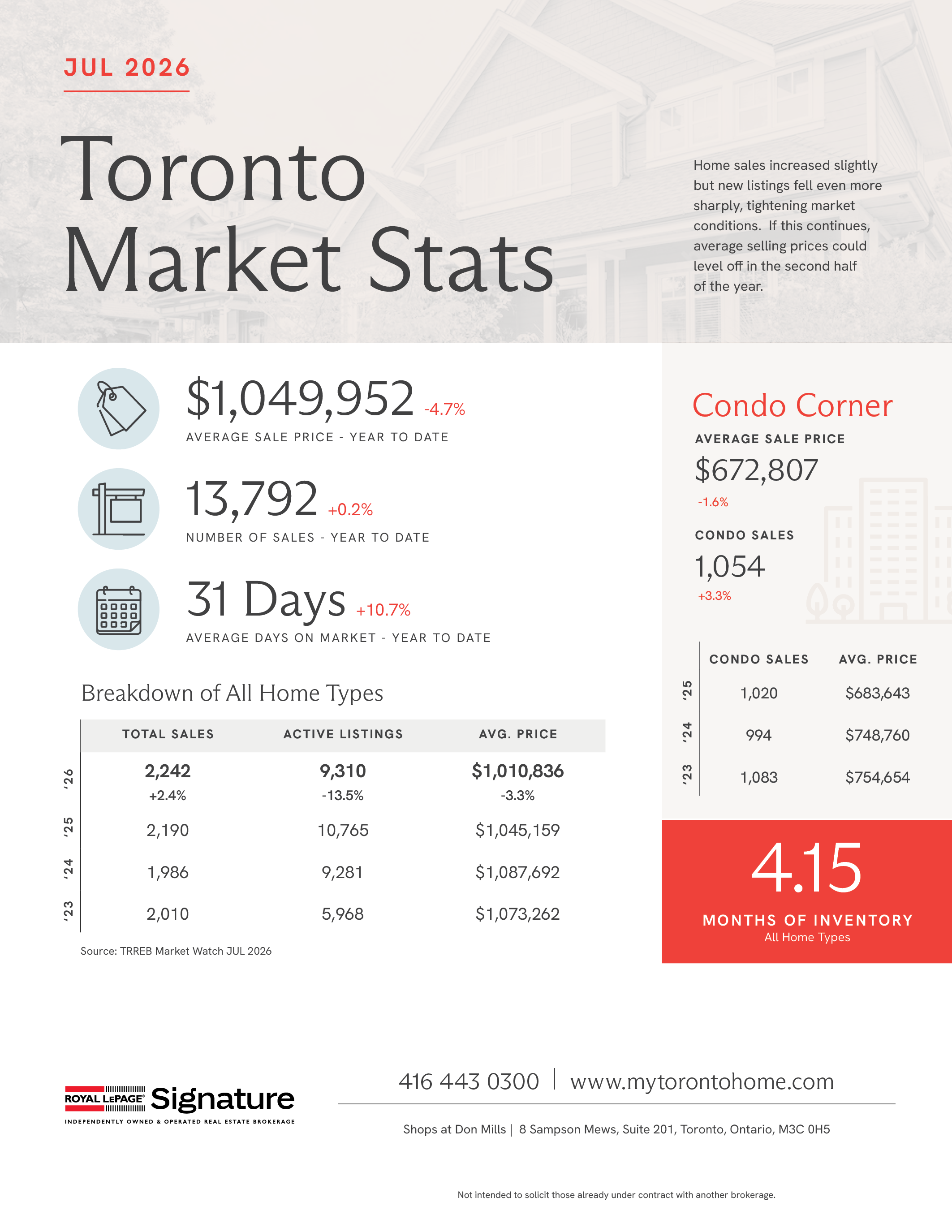
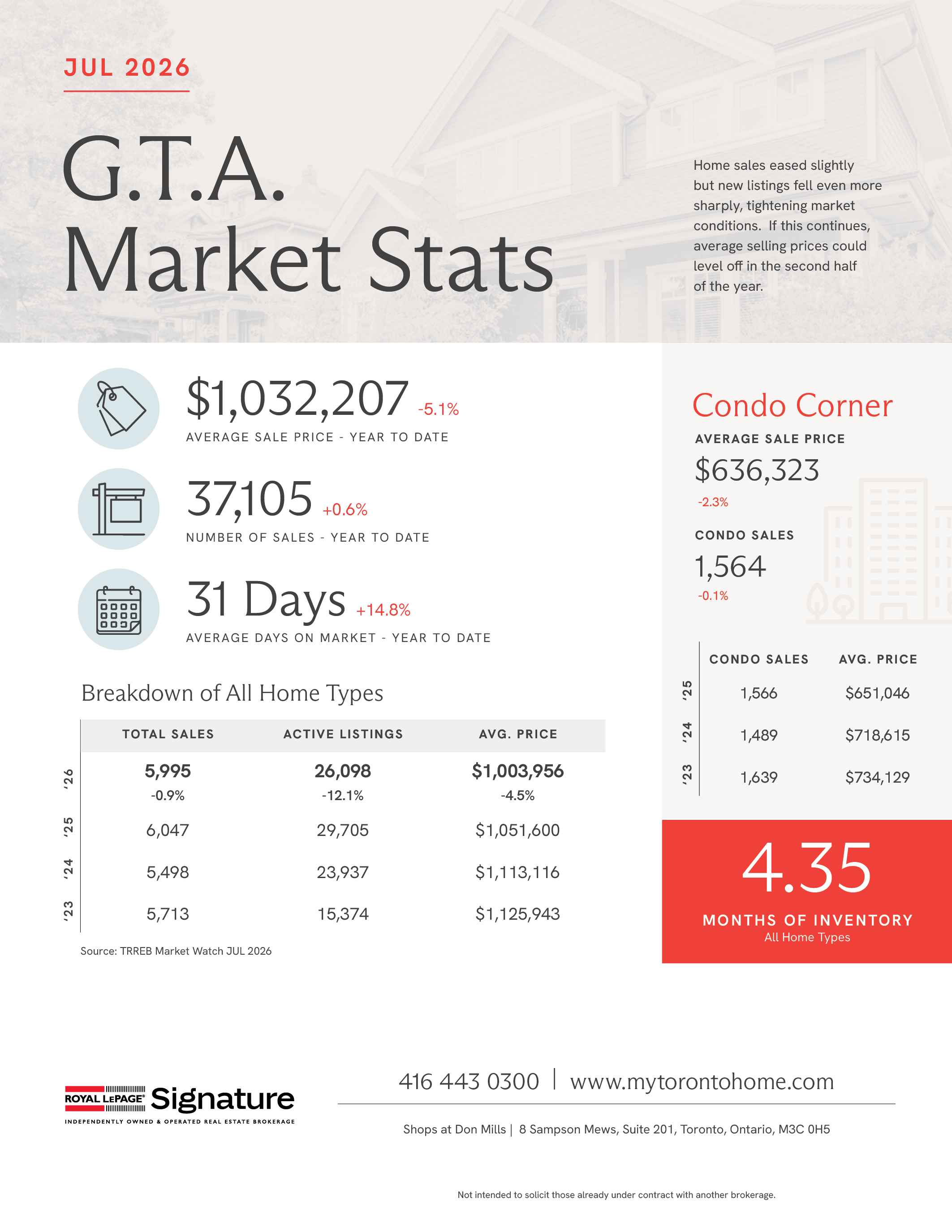
The Toronto Regional Real Estate Board reported 5,995 home sales, just 0.9% lower than July 2025.
Nothing exciting there.
But here's the number that caught my attention.
New listings dropped nearly 18%.
Only 14,484 homes came onto the market in July compared to last year.
That matters.
Because when fewer homes are available but buyers are still purchasing, competition naturally starts to increase.
It's Economics 101.
Less supply. Similar demand.
That's exactly the type of environment that helps stabilize prices—and eventually pushes them higher.
The Market Has Been Quietly Improving All Year
One of the biggest misconceptions right now is that "nothing is happening."
Actually... quite a lot is happening.
Since the beginning of 2026 we've seen transaction volumes steadily improve month after month. Buyers are becoming more active, sellers are becoming more realistic with pricing, and the gap between the two is starting to narrow.
One of the metrics I pay particularly close attention to is the Sales-to-New Listings Ratio (SNLR).
It's one of the strongest indicators of market direction.
Earlier this year that number sat around 32%.
Today it's climbed to 39%.
Why does that matter?
Historically, once that ratio moves into roughly the 42%–45% range, we typically begin to see broader price appreciation across the GTA.
We're not there yet.
But we're heading in that direction.
And markets don't suddenly flip overnight—they evolve.
A Four-Year Reset
It's hard to believe we're now four years removed from one of the biggest turning points in Canadian real estate.
The rapid interest rate increases dramatically changed the market almost overnight.
Home sales slowed.
Prices corrected.
Confidence disappeared.
Since then we've experienced inflation, shifting immigration policies, changing lending conditions, and plenty of economic uncertainty.
It's been a challenging stretch for homeowners, buyers, and yes—even Realtors.
But here's what's important.
Those extraordinary conditions that fuelled the pandemic housing boom were never meant to last forever.
Today's market is far healthier.
Interest rates are more normalized.
Inflation has cooled.
Population growth is becoming more sustainable.
The market has spent the last four years resetting itself.
Now we're beginning to see what comes next.
What Do the Numbers Actually Say?
Here's a quick snapshot of July's market:
- 5,995 homes sold, down just 0.9% from last July.
- 14,484 new listings, down 17.8% year over year.
- Average selling price: $1,003,956, down 4.5% compared to last year.
- On a month-over-month basis, the MLS Home Price Index actually increased slightly, suggesting prices may be stabilizing.
- Condominium sales remained steady, while condo prices declined a modest 2.3% year over year.
One month's data never tells the whole story.
But trends do.
And the trend we've been watching all year continues to move in a positive direction.
So... Is Now a Good Time to Buy?
This is probably the question I'm asked most often.
My answer?
If you're buying for the long term—not the next 12 months—the opportunity today is very compelling.
Buying always feels easiest when everyone else is buying.
Ironically, that's often when competition is highest.
Today buyers have negotiating power, more choice than we've seen in years, and prices that remain well below the frenzied peaks of 2022.
History tells us that Toronto real estate has averaged over 6% annual appreciation over the past 45 years.
No market goes straight up.
But long-term real estate ownership has consistently rewarded patient buyers.
What About Sellers?
Many homeowners worry they've "missed the market."
In reality, that's rarely the case.
While prices remain below their peak, they're still tracking remarkably close to long-term appreciation trends.
Well-prepared, well-priced homes continue to sell.
The difference today is that strategy matters more than ever.
Pricing accurately, preparing your home properly, and marketing it effectively can make the difference between selling quickly and sitting on the market wondering what happened.
Gone are the days when simply putting up a "For Sale" sign was enough.
Looking Ahead to the Fall Market
The next 90 days will tell us a lot.
If sales continue improving while new listings remain constrained, we could see the market shift further toward sellers as we head into 2027.
We're not expecting overnight price spikes or another pandemic-style frenzy.
That's not healthy—and frankly, nobody should want that.
What we're watching for is something much more sustainable:
A balanced market with gradual price growth, improving consumer confidence, and stronger long-term fundamentals.
That's exactly the kind of market both buyers and sellers can succeed in.
Cutting Through the Noise
Let's be honest.
There has never been more real estate advice floating around on social media.
Some of it's helpful.
A lot of it isn't.
Every day I see headlines predicting crashes, booms, bubbles, or the "perfect" time to buy.
The truth usually lives somewhere in the middle.
That's why I rely on data—not drama.
By combining Toronto Regional Real Estate Board statistics with research from Urbanation, we're able to look beyond the headlines and understand what's really happening in our market.
Because buying or selling a home isn't about reacting to the latest viral headline.
It's about making smart decisions based on facts.
The Bottom Line
The Toronto market isn't roaring back overnight—but it's quietly becoming healthier.
Inventory is tightening.
Buyer activity is increasing.
Consumer confidence is improving.
Those are exactly the types of signals we look for before meaningful market growth begins.
Whether you're planning to buy your first home, upsize for your growing family, downsize, or simply want to understand what your home is worth in today's market, understanding these trends can help you make better decisions.
And if you're wondering how all of this affects your plans, let's chat. Every neighbourhood, every home, and every family's situation is different. Together, we can build a strategy based on today's market—not yesterday's headlines.